
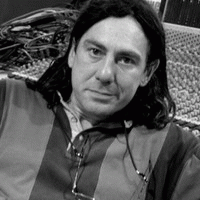
Tony Cohen
Imię
Tony Cohen
Data urodzin
04 Czerwiec 1957
Data zgonu
02 Sierpień 2017
Państwo
Australia 
Miasto
Melbourne
Anthony Lawrence Cohen was born on 4 June 1957 in Melbourne.[1]: 1 His father, Philip Cohen, was an Australian son of Jewish migrants from Manchester, Philip had converted to Roman Catholicism before marrying Margaret, who was an Australian of Irish descent.[1]: 1–2 He grew up in suburban East Ringwood where he attended St Francis de Sales Primary School.[1]: 1 The family moved to Mentone with a younger sibling, where Cohen was enrolled at St Bede's College for his secondary education.[1]: 4 While at Bede's he started taking drugs including marijuana/hash, amytal and LSD, which adversely affected his academic progress.[1]: 3–5 Cohen started to play the drums when the family had moved to the neighbouring suburb of Cheltenham and formed a friendship with fellow aspiring drummer, Chris Thompson.[1]: 7 He later recalled, "Neither of us were very good drummers I might admit but we shared a mutual love of music and playing."[1]: 7
Cohen, aged 15, joined a rock, glam rock band Epitaph on drums for a year.[1]: 9–12 He bought a four-track recorder to tape their work and then recorded other local groups.[1]: 12 During school holidays in mid-1973 he spent two weeks doing work experience at Armstrong Studios. His friend Thompson went along for a day and both decided on a career in the recording studio. After work experience he refused to return to school but continued at the studios, "No one said anything, so I stayed."[1]: 13 For two years he was a "shit-kicker", and started by, "cleaning the toilets and getting the lunches and stuff, and then got promoted to mono dubbing boy."[1]: 15 By 1975 Cohen began working as a sound engineer under the guidance of Roger Savage.[1]: 15 In April of the following year he was working as an assistant record producer, alongside Molly Meldrum, on Perth's glam rock group, Supernaut's lead single, "I Like It Both Ways" (May 1976).[2] Cohen produced the group's associated self-titled album, which appeared in November of that year, and its follow-up single, "Too Hot to Touch" (September).[3]
In July 1976 Cohen and fellow engineer, Ian MacKenzie, met with Meldrum to organise the production of pop group, the Ferrets' debut album, Dreams of a Love: "It was all a bit of Elton John, a bit of the 'Real Thing', [Meldrum] called us in for a production meeting 9:00 in the morning at his place and he was still in bed [...] and putting the music on [...] very, very loud and then proceeds to shout at you over the top of it, and we were all sitting there sort of terrified thinking, what on earth is he saying?"[4] After a year production was still incomplete so the Ferrets took over, together with Cohen and MacKenzie assisting.[5] It was finalised in August 1977 and released in October with Meldrum credited as Willie Everfinish.[5][6]
In June 1978 Cohen started working with the Boys Next Door (later renamed the Birthday Party), as engineer at Richmond Recorders on their debut album, Door, Door (1979). He then engineered the Birthday Party's early extended play, Hee Haw (December 1979). Next he was the engineer and producer, on their second album, The Birthday Party (November 1980).[3][7][8] He was engineer and producer for their third album, Junkyard (May 1982), which was listed in the book, 100 Best Australian Albums at number 17.[9]: 72–3 Cohen told the authors that he was directed, "Forget all the bottom end and the rich, lush sounds. Make it sound like trash."[9]: 72–3 He continued as engineer and/or producer for the group's leader, Nick Cave, in the related group, Nick Cave and the Bad Seeds. From From Her to Eternity (18 June 1984) to No More Shall We Part (2 April 2001).[3][10] Cohen followed the group to London in mid-1986 and then on to Berlin in January 1987 to continue to work with Cave.[1]: 113, 120 [11] He returned to Melbourne in January 1988 with his drug habit "spiraling out of control."[1]: 137
Cohen reflected on his early work with Cave, in an interview with Richard Fidler in September 2006, "[it] was all very experimental then, because we were all learning – I fell in love with this new way of recording... because there were no rules. We were looking for sounds that made your fillings drop out rather than pleasant pop tunes, so we got to do crazy things like find concrete stairwells and abuse equipment, so it was all very attractive for me. Some of it didn't work, but as history has shown Nick really honed his craft, he's done some brilliant records... some of the early stuff was a bit rough but it was a learning curve then."[4] Ed Nimmervoll, an Australian music journalist and editor of Rock Australia Magazine, recalled "Nick Cave's Birthday Party were allowed to take up some of the studio time slack. Rather than [go] home, their producer Tony Cohen slept in the air conditioning duct."[12]
A long-term working relationship had also been established with Tex Perkins, starting with the singer's alternative rock group, Beasts of Bourbon's 1984 album, The Axeman's Jazz.[13] Cohen had engineered and produced it during a single eight-hour session at Paradise Studios in Sydney, in October of the previous year, with label boss Roger Grierson as executive producer.[3][13] According to Australian musicologist, Ian McFarlane, "Legend has it that the session was fuelled by 72 cans of beer and one bottle of Scotch, and that it only ended when the band members began passing out!"[13] He produced their next studio album, The Low Road, (December 1991). In the following year he was their engineer, producer and mixer for a five-track EP, Just Right, which had been recorded live at the Prince of Wales Hotel in May 1991 by Cohen's childhood friend, Chris Thompson.[14]
Cohen's services were used for Perkins' next band the Cruel Sea on their second studio album, This Is Not the Way Home (October 1991). He was nominated at the ARIA Music Awards of 1993 for Producer of the Year for that album and for "Get Thee to a Nunnery", a track on TISM's EP, The Beasts of Suburban (20 July 1992).[15] He worked for an ad hoc country blues trio of Perkins, Don Walker and Charlie Owen, as Tex, Don and Charlie on their debut album, Sad But True (November 1993).[9]: 218–9 While recording that album he was interviewed in the studio by Kerry Negara, the director of SBS-TV's Nomad. At the following year's ARIA Awards ceremony he won Producer of the Year for the Cruel Sea's third album, The Honeymoon Is Over (May 1993).[15][9]: 174–5
In 1995 he won both Engineer of the Year and Producer of the Year.[15] Over the previous 18 months – the eligibility period – Cohen had produced Let Love In (Nick Cave and the Bad Seeds, 18 April 1994),[16] You Wanna Be There But You Don't Wanna Travel (Dave Graney 'n' the Coral Snakes, June 1994), Parables for Wooden Ears (Powderfinger, 18 July 1994), Livin' Lazy (Maurice Frawley and Working Class Ringos, 1994), Three Legged Dog (the Cruel Sea, April 1995),[17] Kim Salmon and the Surrealists (Kim Salmon and the Surrealists, April 1995) and Mouth to Mouth (the Blackeyed Susans, July 1995).[3][10][18]
In the 2000s Cohen's name started appearing less regularly on album credits. During 2003 he worked as a remix engineer on Nick Cave and the Bad Seeds' old master tapes for Stephen Petronio's contemporary dance work, Underland.[19] Cave was unable to provide new tracks for the project due to time conflicts but allowed his material to be used.[19] Cohen had effectively retired in 2004–2005. He emerged in 2017 to produce Augie March's album Bootikins, as he had always wanted to work with the group. He died unexpectedly before the album's sessions concluded, and Augie March leader Glenn Richards stated "It still amazes me that we got a chance to work with the man. The moments are ours and we will cherish them ... He got us feeling like and playing like a real band again after a long interim, and we made some very good music together."[20] In November 2017 Cohen was posthumously inducted into the Music Victoria Hall of Fame.[21]
Cohen, aged 15, joined a rock, glam rock band Epitaph on drums for a year.[1]: 9–12 He bought a four-track recorder to tape their work and then recorded other local groups.[1]: 12 During school holidays in mid-1973 he spent two weeks doing work experience at Armstrong Studios. His friend Thompson went along for a day and both decided on a career in the recording studio. After work experience he refused to return to school but continued at the studios, "No one said anything, so I stayed."[1]: 13 For two years he was a "shit-kicker", and started by, "cleaning the toilets and getting the lunches and stuff, and then got promoted to mono dubbing boy."[1]: 15 By 1975 Cohen began working as a sound engineer under the guidance of Roger Savage.[1]: 15 In April of the following year he was working as an assistant record producer, alongside Molly Meldrum, on Perth's glam rock group, Supernaut's lead single, "I Like It Both Ways" (May 1976).[2] Cohen produced the group's associated self-titled album, which appeared in November of that year, and its follow-up single, "Too Hot to Touch" (September).[3]
In July 1976 Cohen and fellow engineer, Ian MacKenzie, met with Meldrum to organise the production of pop group, the Ferrets' debut album, Dreams of a Love: "It was all a bit of Elton John, a bit of the 'Real Thing', [Meldrum] called us in for a production meeting 9:00 in the morning at his place and he was still in bed [...] and putting the music on [...] very, very loud and then proceeds to shout at you over the top of it, and we were all sitting there sort of terrified thinking, what on earth is he saying?"[4] After a year production was still incomplete so the Ferrets took over, together with Cohen and MacKenzie assisting.[5] It was finalised in August 1977 and released in October with Meldrum credited as Willie Everfinish.[5][6]
In June 1978 Cohen started working with the Boys Next Door (later renamed the Birthday Party), as engineer at Richmond Recorders on their debut album, Door, Door (1979). He then engineered the Birthday Party's early extended play, Hee Haw (December 1979). Next he was the engineer and producer, on their second album, The Birthday Party (November 1980).[3][7][8] He was engineer and producer for their third album, Junkyard (May 1982), which was listed in the book, 100 Best Australian Albums at number 17.[9]: 72–3 Cohen told the authors that he was directed, "Forget all the bottom end and the rich, lush sounds. Make it sound like trash."[9]: 72–3 He continued as engineer and/or producer for the group's leader, Nick Cave, in the related group, Nick Cave and the Bad Seeds. From From Her to Eternity (18 June 1984) to No More Shall We Part (2 April 2001).[3][10] Cohen followed the group to London in mid-1986 and then on to Berlin in January 1987 to continue to work with Cave.[1]: 113, 120 [11] He returned to Melbourne in January 1988 with his drug habit "spiraling out of control."[1]: 137
Cohen reflected on his early work with Cave, in an interview with Richard Fidler in September 2006, "[it] was all very experimental then, because we were all learning – I fell in love with this new way of recording... because there were no rules. We were looking for sounds that made your fillings drop out rather than pleasant pop tunes, so we got to do crazy things like find concrete stairwells and abuse equipment, so it was all very attractive for me. Some of it didn't work, but as history has shown Nick really honed his craft, he's done some brilliant records... some of the early stuff was a bit rough but it was a learning curve then."[4] Ed Nimmervoll, an Australian music journalist and editor of Rock Australia Magazine, recalled "Nick Cave's Birthday Party were allowed to take up some of the studio time slack. Rather than [go] home, their producer Tony Cohen slept in the air conditioning duct."[12]
A long-term working relationship had also been established with Tex Perkins, starting with the singer's alternative rock group, Beasts of Bourbon's 1984 album, The Axeman's Jazz.[13] Cohen had engineered and produced it during a single eight-hour session at Paradise Studios in Sydney, in October of the previous year, with label boss Roger Grierson as executive producer.[3][13] According to Australian musicologist, Ian McFarlane, "Legend has it that the session was fuelled by 72 cans of beer and one bottle of Scotch, and that it only ended when the band members began passing out!"[13] He produced their next studio album, The Low Road, (December 1991). In the following year he was their engineer, producer and mixer for a five-track EP, Just Right, which had been recorded live at the Prince of Wales Hotel in May 1991 by Cohen's childhood friend, Chris Thompson.[14]
Cohen's services were used for Perkins' next band the Cruel Sea on their second studio album, This Is Not the Way Home (October 1991). He was nominated at the ARIA Music Awards of 1993 for Producer of the Year for that album and for "Get Thee to a Nunnery", a track on TISM's EP, The Beasts of Suburban (20 July 1992).[15] He worked for an ad hoc country blues trio of Perkins, Don Walker and Charlie Owen, as Tex, Don and Charlie on their debut album, Sad But True (November 1993).[9]: 218–9 While recording that album he was interviewed in the studio by Kerry Negara, the director of SBS-TV's Nomad. At the following year's ARIA Awards ceremony he won Producer of the Year for the Cruel Sea's third album, The Honeymoon Is Over (May 1993).[15][9]: 174–5
In 1995 he won both Engineer of the Year and Producer of the Year.[15] Over the previous 18 months – the eligibility period – Cohen had produced Let Love In (Nick Cave and the Bad Seeds, 18 April 1994),[16] You Wanna Be There But You Don't Wanna Travel (Dave Graney 'n' the Coral Snakes, June 1994), Parables for Wooden Ears (Powderfinger, 18 July 1994), Livin' Lazy (Maurice Frawley and Working Class Ringos, 1994), Three Legged Dog (the Cruel Sea, April 1995),[17] Kim Salmon and the Surrealists (Kim Salmon and the Surrealists, April 1995) and Mouth to Mouth (the Blackeyed Susans, July 1995).[3][10][18]
In the 2000s Cohen's name started appearing less regularly on album credits. During 2003 he worked as a remix engineer on Nick Cave and the Bad Seeds' old master tapes for Stephen Petronio's contemporary dance work, Underland.[19] Cave was unable to provide new tracks for the project due to time conflicts but allowed his material to be used.[19] Cohen had effectively retired in 2004–2005. He emerged in 2017 to produce Augie March's album Bootikins, as he had always wanted to work with the group. He died unexpectedly before the album's sessions concluded, and Augie March leader Glenn Richards stated "It still amazes me that we got a chance to work with the man. The moments are ours and we will cherish them ... He got us feeling like and playing like a real band again after a long interim, and we made some very good music together."[20] In November 2017 Cohen was posthumously inducted into the Music Victoria Hall of Fame.[21]